
A NEW FRAMEWORK FOR UNDERSTANDING & HEALING DEVELOPMENTAL TRAUMA

Your symptoms are not the wound. They are the evidence of what the wound required of you.


THE MISSION
I decode the hidden architecture of developmental trauma — replacing confusion with coherence, shame with understanding, and survival adaptation with the development of a whole, sovereign self.
Developmental trauma is not only about painful experiences, or what did or did not happen.
It is about what those experiences interrupted.
The ability to fully arrive in your own life.
To know your body belongs to you alone.
To rest inside a relationship without working at it all the time.
To know that the world has a place for you in it, and you belong.
To carry dignity, instead of shame, within you.
These are not personality traits.
They are developmental capacities that form in childhood.
And when they are interrupted, no amount of insight, willpower, or coping can replace what was never built.
Healing is not only about processing the past, but about restoring what the past prevented - so that development, at last, can resume.

Something happened to you that was never named.
You’ve done the therapy. Read the books. Tried the strategies.
And still — something doesn’t shift.
You function. Sometimes beautifully.
But underneath, there’s an exhaustion that sleep doesn’t fix. A vigilance that never fully turns off. A feeling of being fundamentally alone — even in rooms full of people who love you. A deep knowing that you are different from others in a way that feels unfixable.
None of that worked. Not because you weren’t trying. But because no one ever told you the truth.
You were not broken. You were interrupted.

Maybe you can be surrounded by people and still feel strangely lonely - outside the experience of being held by life. You wish you felt more chosen, more wanted.
Maybe you do not fully trust the people closest to you - or you trust too quickly, too completely, and then brace for the moment to fall apart.
Maybe you have carried, for as long as you can remember, a deep conviction that something is fundamentally wrong with you - when what was wrong was what was done to you.
Maybe you have built a life that looks like yours but actually does not feel like yours - and you are not sure who you are underneath the survival.
Maybe the world does not make sense to you in the way it seems to make sense to others - and you carry a quiet weight that feels like nameless grief.

Something happened to you that was never named.
You’ve done the therapy. Read the books. Tried the strategies.
And still — something doesn’t shift.
You function. Sometimes beautifully.
But underneath, there’s an exhaustion that sleep doesn’t fix. A vigilance that never fully turns off. A feeling of being fundamentally alone — even in rooms full of people who love you. A deep knowing that you are different from others in a way that feels unfixable.
None of that worked. Not because you weren’t trying. But because no one ever told you the truth.
You were not broken. You were interrupted.
Maybe you can be surrounded by people and still feel strangely lonely - outside the experience of being held by life. You wish you felt more chosen, more wanted.
Maybe you do not fully trust the people closest to you - or you trust too quickly, too completely, and then brace for the moment to fall apart.
Maybe you have carried, for as long as you can remember, a deep conviction that something is fundamentally wrong with you - when what was wrong was what was done to you.
Maybe you have built a life that looks like yours but actually does not feel like yours - and you are not sure who you are underneath the survival.
Maybe the world does not make sense to you in the way it seems to make sense to others - and you carry a quiet weight that has feels like nameless grief.


What you’re experiencing is not a disorder. It’s the legacy of growing up without protection, attunement, and safety - the conditions required for healthy development.
It’s developmental trauma. And you need to know how it makes sense.
You are no longer interested in simply coping with the impact of trauma, but in understanding what was interrupted developmentally, and whether it can truly be repaired.
SURVIVORS
“I shouldn’t feel this way.”
“Nothing really happened to me.”
“Why can’t I get unstuck?”
“I don’t know who I am.”
“I feel like I’m not in my own life.”
CLINICIANS
You work with clients who are intelligent, insightful, and deeply suffering - yet something underneath never fully shifts.
You sense that regulation alone is not enough.
You are looking for a deeper developmental map for understanding:
Chronic shame
Dissociation
Attachment disturbances
Personality organization
High-control family systems
Complex trauma
And the survival architectures that form around interrupted development.
You are looking beyond symptom management toward a deeper understanding of developmental survival organization- and its repair.

Start Here.
Understand the five core wounds of developmental trauma - and why your patterns make sense.
Download Your Free Guide Today!

Developmental Trauma
You are not broken.
You’re brilliantly adapted.
The patterns that exhaust you now once kept you alive.
Developmental trauma is not what most people think of when they hear the word “trauma.” It isn’t a single event. It’s what happens when a child’s development unfolds without the protection, attunement, or safety that every nervous system requires to form properly.
When those conditions are absent — through neglect, emotional abandonment, coercion, incest, religious control, or high-control family systems — the developing brain and body don’t stop growing.
They grow around the wound.
The child adapts.
Beautifully. Intelligently.
At great cost.
Anxiety becomes a permanent alarm system. Perfectionism becomes a survival strategy. Dissociation becomes the only way to stay in the room. Shame becomes the organizing principle of identity.
These are not symptoms to be managed. They are survival strategies to be understood, mapped, and healed.
Developmental trauma is not a diagnosis. It is interrupted development that must be understood, mapped, and completed.

MEET YOUR GUIDE
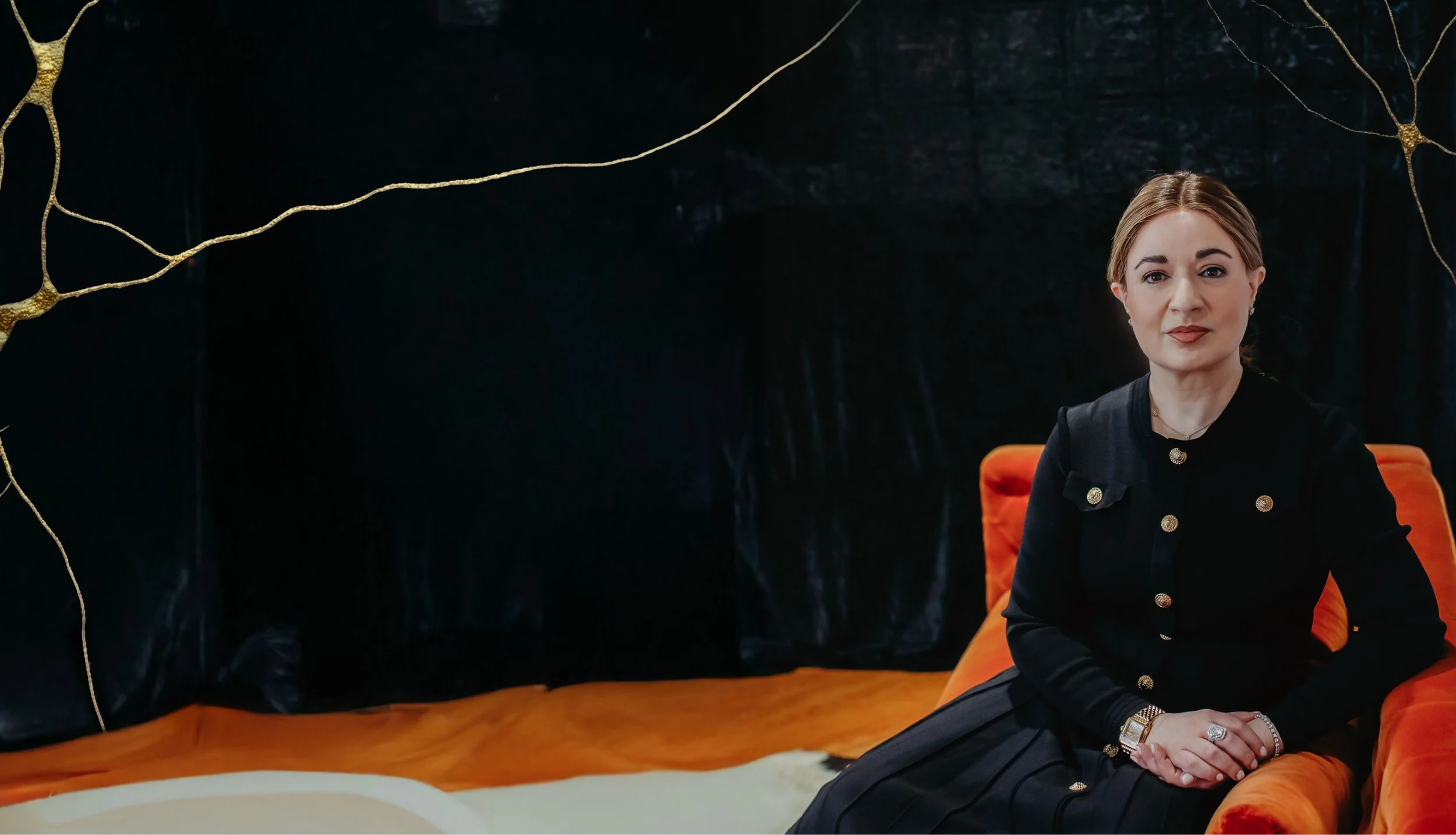
Zipa Leah Scheinberg
Developmental Trauma Theorist & Clinician
What distinguishes her is her creation of a developmental framework that understands trauma as an interruption in the formation of core human capacities.
She offers a clear, layered map for restoring the foundational capacities that allow a person to reclaim dignity and sovereignty so life can flow, rather than simply be managed.
She is the creator of the BITES framework, which maps the core wounds developmental trauma creates and the seven architectural adaptation patterns that emerge as the mind and body organize around survival.
She practices in New York, working for almost two decades with complex psychological trauma, incest and sexual abuse, dissociation, high-control religious and family systems, attachment issues, childhood neglect, “treatment-resistant” diagnoses, therapeutic impasse, and vicarious trauma for the therapist.
Her work is grounded in neuroscience, attachment theory, developmental psychology, trauma research, and somatic frameworks.
Survivors who encounter her work often say, “For the first time, my life makes sense.”
-
Clinicians say Zipa Leah gives them both the map and the method: “For years I could see these patterns in trauma survivors but didn’t have a clear map for them. This framework shows us not only what happened developmentally, but how we can begin to repair it. I know what to do differently now.”
Zipa Leah is known for her warmth, compassion, clarity, and depth of knowledge as a clinician and teacher, and for her capacity to present complex issues in easily understood and clear ways. She is sought as a consultant and supervisor, and as a lecturer on topics related to trauma, dissociation, attachment, and psychotherapy. She enjoys collaborating with colleagues around the world on clinical and educational projects.
Credentials & Training:
Zipa Leah Scheinberg holds an MSW from Fordham University, where she graduated as valedictorian, and is a licensed clinical social worker in New York State. She is EMDRIA certified, EMDR Consultant, and AEDP-trained. She has specialized training in somatic and polyvagal approaches, structural dissociation, and trauma-informed yoga.
Zipa Leah specializes in:
Developmental trauma - Wounds that form before memory · Sexual abuse and incest in families · High control relationships · Dissociation · Multigenerational trauma · Spiritual abuse · Complex trauma

THE WORK
Developmental Trauma, Decoded™
A framework for understanding what happened, why it persists, and how healing unfolds.
At the center of Zipa Leah’s work is a single, clarifying truth: developmental trauma is not a disorder to be managed. It is what happens when the child organizes around survival, instead of growth. It is interrupted development that must be understood, mapped, and completed.
The Developmental Trauma, Decoded™ framework answers three questions you may have been carrying your entire life:
What did it take from me - and why does it still affect everything, even now?
Why do I keep returning to patterns I consciously want to change?
Is it possible to go back and build what was never built? Not to cope with the damage, but to actually repair it?
It is.
And there is a map.
The framework integrates three interlocking components:

1. THE FRAMEWORK
The Five Core Wounds of Developmental Trauma





BELONGING
A felt sense of exile from self, other people, and life itself.
IDENTITY
A self organized around survival instead of development.
TRUST
An inverted alarm system — danger feels familiar, safety feels threatening.
EXISTENTIAL MEANING
Loss of coherence, purpose, or sacredness of life.
SHAME
The central organizing belief of developmental trauma - that what happened to you says something fundamental about who you are.

2. THE SEVEN ARCHITECTURAL SURVIVAL PATTERNS
How the Nervous System Protected What Development Could Not







1 | THE PERFECTIONIST STRATEGY
Safety through control, performance, and impossibly high standards
2 | THE GHOST STRATEGY
Safety through invisibility, numbing, and dissociation
3 | THE GUARDIAN STRATEGY
Safety through protecting others while suppressing personal need
4 | THE CHAMELEON STRATEGY
Safety through adaptation and loss of stable identity
5 | THE WARRIOR STRATEGY
Safety through vigilance, strength, control of threat
6 | THE ACHIEVER STRATEGY
Safety through earned worth
7 | THE SCAPEGOAT STRATEGY
Safety through carrying projected shame for the system

3. THE DEVELOPMENTAL REPAIR ARC
How Healing Actually Happens
PHASE 1: DECODING
“I finally understand why I am this way.” My life finally makes sense.”
PHASE 2: REGULATION
& SAFETY
“My nervous system no longer experiences life as a constant threat.”
PHASE 3: IDENTITY
DEVELOPMENT
“I exist as a self — not just a responder.”
PHASE 4: INTEGRATION & SOVEREIGNTY
“I am living from myself, not from trauma.”

WORK WITH ME
There is a path forward.
It’s structured, intentional, and it is grounded in developmental science.
1:1 Clinical Work
Zipa Leah works with a limited number of individual clients. Her clinical practice is grounded in EMDR, AEDP, polyvagal theory, parts work, and somatic approaches, and the Developmental Trauma, Decoded™ framework. Inquiries by consultation only.
Developing the Self You Never Got to Become
— Signature Program
COMING SOON
A self-paced, developmentally sequenced digital repair program for adults living with the effects of early trauma. Four phases. Clinically contained. Deeply validating.
You Aren’t Alone Anymore — Membership
COMING SOON
A structured membership offering clarity, language, and developmental repair for survivors ready to understand themselves and develop the self that never got to fully form.
Practitioner Training
COMING SOON
Clinical foundations and advanced application trainings for licensed therapists, social workers, EMDR clinicians, and somatic practitioners who want a developmental trauma lens.

BRING ZIPA LEAH TO YOUR AUDIENCE
Keynotes, Workshops & Podcast Guest Appearances
Zipa Leah Scheinberg speaks on developmental trauma with the precision of a clinician and the clarity of someone who has lived through it.
Her keynotes leave audiences saying: “You just explained my entire life.”

She is available for keynotes, conference presentations, panels, workshops, podcast interviews, and continuing education events.
Developmental Trauma, Decoded™ — Why what you’re experiencing makes sense, and how healing actually happens.
You Make Sense — Why your “symptoms” are intelligent, and what they’ve been protecting.
The Self That Never Got to Develop — Identity repair after developmental trauma.
Treating Trauma at the Root — A developmental lens for clinicians working with complex trauma.
Signature Topics:
Mental health conferences · University programs · Corporate wellness · Faith and post-faith communities · Women’s conferences · Healing retreats · Podcasts on trauma, psychology, parenting, relationships, and personal development
Ideal for:

A MOVEMENT FROM SURVIVAL TOWARD DIGNIFIED SELFHOOD
Developmental Trauma, Decoded™ is building a world where survivors of developmental trauma are no longer misunderstood, misdiagnosed, or left to navigate shame alone — but instead given precise frameworks, compassionate guidance, and the developmental repair they deserved from the beginning.
The Movement Stands For:
Clarity instead of chronic confusion.
Language instead of frozen silence.
Presence instead of performed existence.
Wholeness instead of fragmented adaptation.
Compassion instead of internalized shame.
Developmental Trauma, Decoded™ is building a world where survivors of developmental trauma are no longer misunderstood, misdiagnosed, or left to navigate shame alone — but instead given precise frameworks, compassionate guidance, and the developmental repair they deserved from the beginning.
A MOVEMENT FROM SURVIVAL TOWARD DIGNIFIED SELFHOOD
Clarity instead of chronic confusion.
Language instead of frozen silence.
Presence instead of performed existence.
Wholeness instead of fragmented adaptation.
Compassion instead of internalized shame.
The Movement Stands For:

THE WORKBOOK
Belonging
A Trauma-Informed Experiential Workbook for Repairing Early Childhood Wounds
The first workbook in the Developmental Trauma, Decoded™ series.
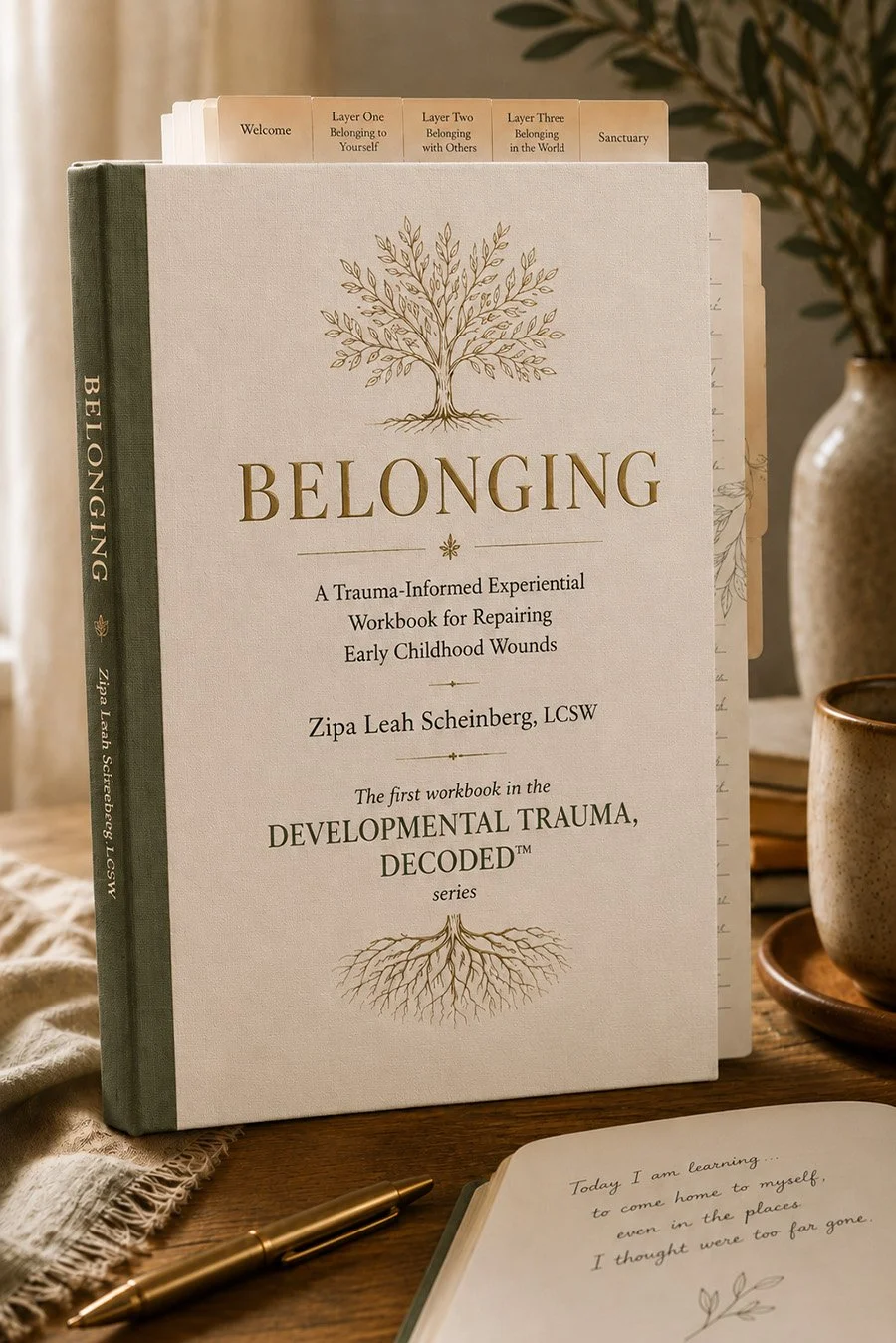
Belonging is an experiential workbook for thoughtful, psychologically-minded adults who sense that beneath their anxiety, perfectionism, overfunctioning, emptiness, or chronic self-doubt lies something deeper: a wound in belonging itself.
This workbook is not built around pathology.
It is built around understanding.
Grounded in nearly two decades of clinical work and developmental trauma research, Belonging helps readers understand how early relational wounds shape the nervous system, identity, relationships, and the way a person comes to experience themselves in the world. It is not a checklist of what's wrong with you.
Moving through the three developmental layers of belonging — belonging to yourself, belonging with others, and belonging in the world — the workbook offers structured experiential practices designed to engage the body, mind, heart, and soul.
This is not a checklist of what is wrong with you.
It is a map of what happened to you — and a guided path toward repair.
Inside, you will learn how developmental wounds around being unwanted, unseen, emotionally alone, or chronically unsafe continue to organize present-day experience. You will begin developing the foundational capacities necessary for healing: tracking, containment, regulation, self-recognition, and internal steadiness.
Because what gets called pathology is often the unfinished developmental intelligence of a child who had no other way through.
Have you ever felt deeply alone, even while surrounded by people who love you?
Have you ever built a life that looks strong from the outside, yet privately carried the feeling that something essential inside you never fully formed?
Have you moved through the world with a quiet but persistent sense that other people seem to belong here in a way you do not?
Many people living with developmental trauma carry this feeling for years — sometimes for decades — without language for it. Not because they are broken, but because important parts of development were interrupted long before they had words for what was happening to them.

What you can expect as you move through this workbook:
More ability to remain emotionally present with yourself without immediately collapsing into shame, self-rejection, overwhelm, numbness, performance, or self-abandonment.
Rewire disturbing imprints in your brain using trauma-informed skills
A felt sense of belonging to yourself — and, perhaps for the first time, the experience of relating to your inner world with curiosity instead of chronic self-rejection.
More connection to your body, your emotions, your needs, your instincts, and your humanity.
And over time, the possibility of experiencing yourself not as someone who is fundamentally “too much,” “not enough,” or outside the circle of belonging — but as a human who can now begin developing a life rooted in connection, presence, and belonging.
The workbook includes:
The Three Foundational Skills: Tracking, Safe-Enough Place, and Containment
The Three Layers of Belonging
Body, heart, mind, and soul practices for each layer
Reflective exercises and journaling prompts
Weekly integration and tracking logs
The closing chapter, Sanctuary
A note specifically for survivors of dehumanization
COMING IN SEPTEMBER
Start Here.
Understand the five core wounds of developmental trauma — and why your patterns make sense.
Receive writing on developmental trauma, the framework as it evolves, and announcements about courses.
Sent occasionally.
Always with care.
What Survivors Say:
What Clinicians Say:
“You make sense. Your patterns make sense. And healing is possible — not through suppression or coping alone, but through the gradual expansion of your nervous system’s capacity for safety, connection, and joy. ”


LET’S CONNECT
You've read this far for a reason.
Whatever brought you here — recognition, relief, the long-delayed sense that something finally fits — there is a next step shaped for it.
FOR SURVIVORS
Start with the BITES Guide.
If you're beginning to understand your own life through this lens, the Guide is the clearest entry point — a short, grounding introduction to the five core wounds of developmental trauma.

FOR CLINICIANS
Deepen your developmental lens.
For mental health professionals working with complex trauma, dissociation, and "treatment-resistant" presentations.
Sign up for clinical writing and updates on forthcoming practitioner training.
FOR EVENTS, MEDIA & PODCASTS
Bring this work to your audience.
Zipa Leah is available for keynotes, workshops, panels, podcast interviews, and continuing education events.
Stay close to the work.
Receive writing on developmental trauma, the framework as it evolves, and announcements about courses.
Sent occasionally.
Always with care.
This work is built slowly, with care, and in conversation with the people it's for.
Thank you for being here.